






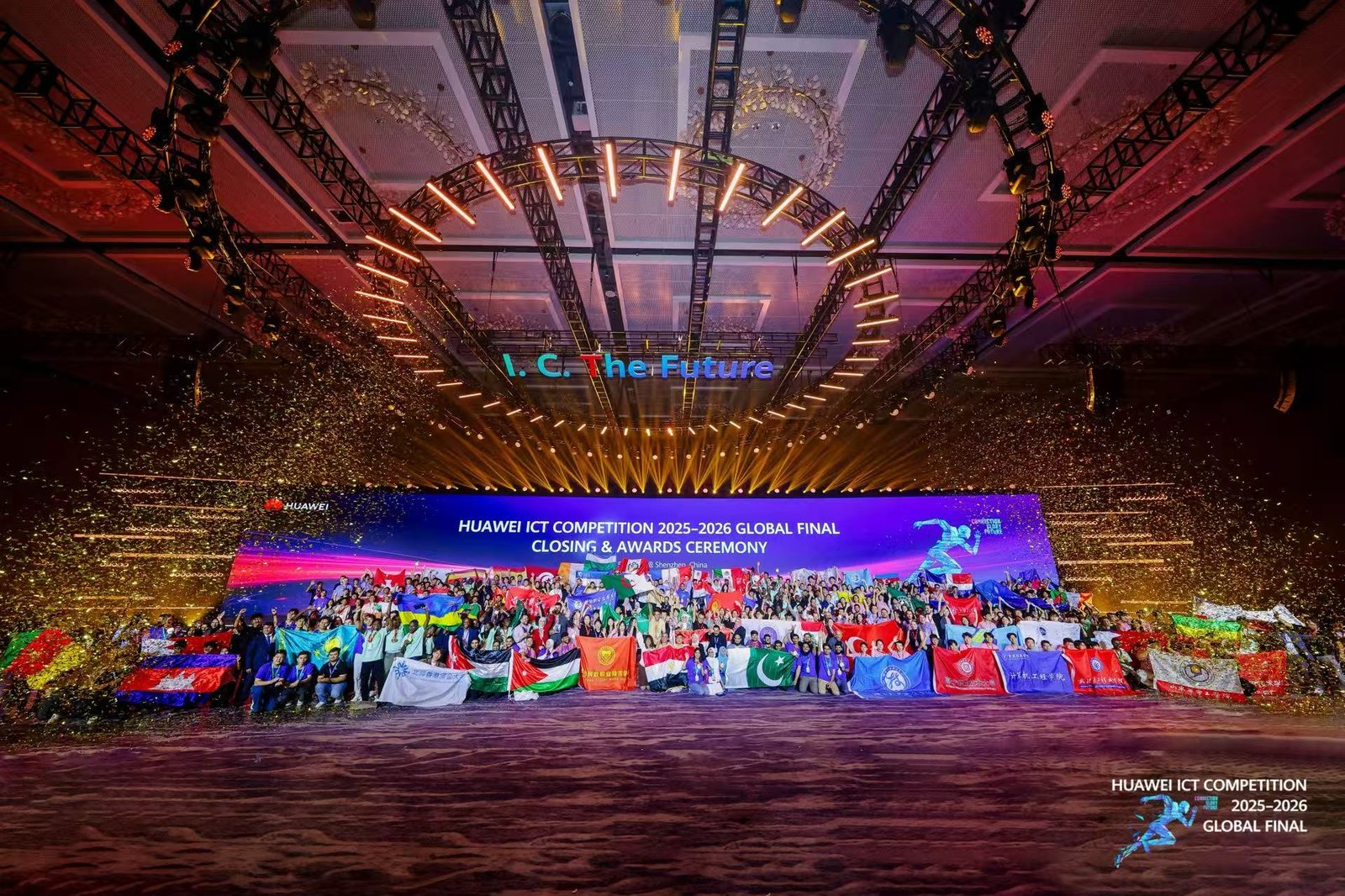
SHENZHEN, June 5 : Pakistani university teams excelled at the Huawei ICT Competition 2025-26 Global Final, bringing home four prestigious awards at the ceremony held on Friday in Shenzhen, China. The event saw participation from more than 220,000 students and faculty from over 2,000 universities across 100+ countries, making it the largest edition in the competition’s history.
Distinguished guests, including Pakistan’s Ambassador to China, Khalil Hashmi, graced the occasion.
A team comprising Farman Ullah, Nauman Sajjad, Adeeba Mubarak, and Hira Khurshid, representing COMSATS University, Abbottabad, Lahore Garrison University, and UET Taxila, secured the second prize in the Practice Competition – Computing Track.
Another team, consisting of Dr. Muhammad Asim, Muhammad Umar Farooq, Talha Asghar, and Malik Uzzam Arif from FAST University Islamabad, won third prize in the Innovation Competition.
In the Practice Competition – Network Track, Saqib Hussain, Muhammad Nauman Khan, Navera, and Inam Ullah, representing Mehran University of Engineering & Technology and Sindh Agriculture University, clinched third prize.
Meanwhile, Muhammad Rashid Mukhtiar was honored with the Most Valuable Instructor Award for his outstanding guidance.
This year marked the 10th edition of the Huawei ICT Competition, which featured three major tracks—Practice, Innovation, and Programming—alongside special awards recognizing contributions beyond technical excellence. Highlights included the Women in Tech Award, the Green Development Award, the ICT Competition Online Popularity Award, and Fast Passes for top students to Huawei’s Future Business Leader Track.
At the Closing & Awards Ceremony, Ritchie (Honghua) Peng, President of Huawei ICT Strategy & Business Development, praised the competition’s role in fostering innovation and practical skills. He highlighted that the Innovation Competition encouraged learning through real-world problem-solving, while the Practice and Programming tracks showcased participants’ technical dedication and curiosity. Peng also announced the launch of the Ascend AI Operator Development Track for the next edition in China, aimed at giving young developers hands-on experience with cutting-edge technologies.
Dr. Shafika Isaacs, acting Director of UNESCO Institute for Information Technologies in Education, lauded the Huawei-UNESCO partnership and emphasized the importance of international collaboration in AI and technology education. She noted that participants demonstrated creativity, cross-cultural problem-solving skills, and a responsible approach to technology—qualities essential for the future of AI and digital innovation.
Alongside the competition, Huawei hosted the AI Accelerating Education Transformation Summit, bringing together global educators and industry experts to discuss AI’s role in transforming education. The summit also saw the unveiling of the ICT Academy AI Course Solution, designed to help universities develop AI talent at scale, and the release of the ICT Skills Development Insight Report for nine Central Asian and Caucasus countries, offering guidance for policymakers on nurturing tech talent.
With digital transformation accelerating, Huawei’s ICT Competition continues to provide an international platform for students to enhance technical and practical skills, address real-world challenges, and prepare for the demands of the global digital economy.