
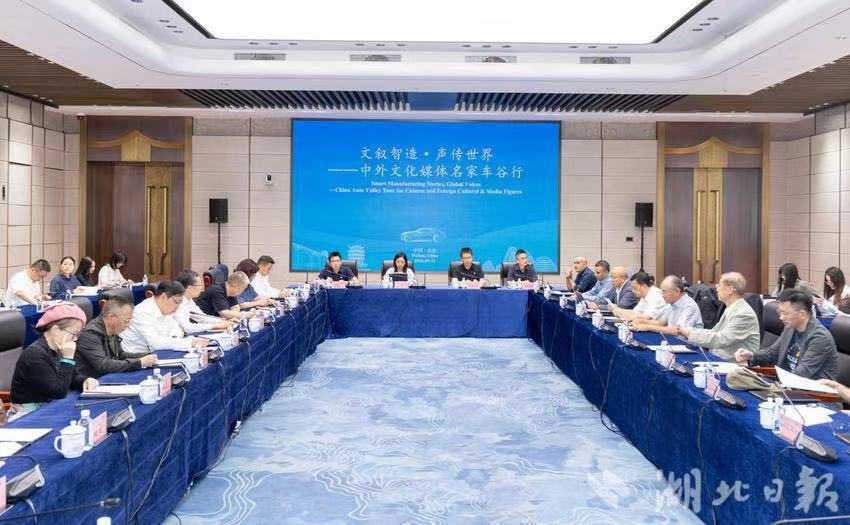
WUHAN, Sept. 12 : Chinese and foreign cultural and media figures gathered in Wuhan for a colloquium focused on intelligent manufacturing, urban development and the global communication of China’s industrial stories.
The event, themed “Smart Manufacturing Stories, Global Voices — China Auto Valley Tour for Chinese and Foreign Cultural & Media Figures,” was held in Wuhan Economic and Technological Development Zone, commonly known as China Auto Valley.
The two-day program, organized by the China International Communications Group (CICG) Academy of Translation and Interpretation brought prominent Chinese and international writers, journalists and media professionals to several major automobile and technology facilities in the zone.
On September 10, the delegation visited the Dongfeng Motor Global Innovation Center, Mengshi Motors, the Lotus Automotive Global Smart Factory and the China Auto Valley Exhibition Center. The guests also experienced autonomous-driving vehicles and observed advanced manufacturing and technological innovations firsthand.
Chen Cang, a recipient of the Lu Xun Literary Award, shared his impressions after visiting several automobile factories and test-driving a vehicle under challenging conditions.
He described driving over rough roads, climbing a 45-degree slope and navigating deep water as an experience that demonstrated the strength, stability and technological capabilities of modern vehicles.
“With the development of technology, the car is no longer merely a means of transportation, but is becoming a space for a better life,” Chen said.
At the September 11 colloquium, participants exchanged views on strengthening local narratives and enhancing international communication. They emphasized the importance of telling stories that connect industrial development with cities, culture and people.
Arina Yakupova, a former correspondent and bilingual Russian-English journalist with Shanghai Daily, suggested producing in-depth interview programs focusing on the people behind China Auto Valley.
She said international audiences should be able to understand what manufacturers are building, what problems they are seeking to solve and how innovation is shaping the future of the automobile industry.
Yakupova also proposed that events such as Wuhan Auto Week could incorporate more interactive experiences rather than functioning solely as commercial exhibitions, helping further develop Wuhan’s identity and international image as a manufacturing hub.
Omar Er-Rouch, editor-in-chief of Morocco’s state news agency in China, said that effective international communication should go beyond production figures and focus on the people and ideas driving the development of China Auto Valley.
“The challenge in international communication is how to combine stories of industry, cities, culture and people,” he said.
Pakistani journalist Mohammad Asghar said Wuhan Auto Valley needed not only world-class modern factories, but also world-class storytelling and global communication capabilities.
Hosam EI-Maghrabi, a recipient of the Chinese Government Friendship Award and a foreign expert and media host at China.org.cn, noted that people tend to remember personal experiences, moments and stories more readily.
Such stories, he said, can help bridge the distance between people and cities and make industrial development more accessible to international audiences.
David W.Ferguson, former honorary English editor-in-chief of Foreign Languages Press and a recipient of the Chinese Government Friendship Award, the Orchid Award for Outstanding Achievement and the Special Contribution Award for Chinese Books, highlighted the role of foreign-funded and joint-venture enterprises in Wuhan Economic and Technological Development Zone.
He said foreign businesspeople working in the zone could serve as important subjects for international reporting and as bridges for cross-cultural communication.
The CICG Academy of Translation and Interpretation, which is dedicated to integrating and coordinating translation resources across China, maintains partnerships with more than 100 mainstream foreign media organizations across all five continents.
Through such cooperation, the institute plays an important role in promoting people-to-people exchanges and strengthening mutual understanding between China and the international community.